Level sensor types: advantages of radar measurement
Radar level transmitters offer benefits over ultrasound or capacitive sensors
A level sensor or transmitter is used to determine the fill height of liquids and bulk materials. As a result, level measurement sensors enable the monitoring of processes in a wide variety of industries – from the food, chemical and pharmaceutical sectors to the oil, water or steel industries. FMCW radar sensors have long been used in level monitoring. In fact, radar level measurement has many advantages over capacitive or ultrasonic sensors, because it provides reliable measuring data even in conditions of dust, steam, smoke, extreme temperatures and strong pressure fluctuations. With OndoSense's innovative radar technology, level monitoring is now possible for the first time with an accuracy in the micrometer range in harsh environments. Radar thus opens up new application areas for level control – for example, in the metal and steel industry or in mining.
What is a level sensor? Where is level measurement used?
Level transmitters are used in various industries to measure fill heights or limits of liquids & solids
-
What is a level sensor? What is a switch?
A level sensor – also called transmitter, gauge or indicator – detects the level of a liquid or solid substance in a container. This can be a silo, a tank, or even a pipe. Level sensors are distinguished from switches: While sensors continuously measure the level of liquids or solids, switches can only detect defined limits. This point level measurement technology is typically used to determine high or low levels. OndoSense radar level transmitters can both measure fill heights as well as detect fill limits.
With continuous level measurement, the sensor usually communicates the fill height digitally as a distance, volume or percentage value to the machine control system or the display. Some level sensors also output the value in analog form via a current interface. OndoSense radar level transmitters have both digital and analog interfaces.
-
How do you measure fill levels?
Sensors measure fill levels either contact-free or in contact with the substance – by using mechanical measurement methods, for example. Most contactless sensors measure fill heights by determining the distance to the surface of the liquid or solid. Level sensors typically emits sound waves or electromagnetic waves, which are reflected back. An ultrasonic level sensor, for example, can calculate the distance to the surface and thus the fill height based on the time of flight and the speed of sound. As a matter of fact, radar level sensors work in a similar way: They determine the distance using the frequency shift between the transmitted and received radar signal. In radiometric level measurement, however, the sensor determines the fill height value based on the medium's absorption of gamma radiation. Capacitive sensors, in turn, calculate the heights of fluids or bulk materials by detecting the variations of their electrical capacitance.
Mechanical level transmitters use a variety of measurement methods: For example, the fill height of liquids can be measured hydrostatically using the pressure difference between the surface and the bottom of the container. A float switch, on the other hand, measures the medium's elevation via the position of a body on a lever or rope. There are many other methods of level control, such as thermal conductivity, superconductivity, vibration sensors, probes, rotary paddles, or plumb bobs.
-
Where is level measurement used? In which objects is level measured?
Level sensors are used in a wide variety of applications, industries and objects. Cars and trucks, for example, use fuel gauges to indicate the level of gas to the driver. Level transmitters in the food, chemical, and pharmaceutical industries measure the fill heights of liquids and raw materials in production containers to ensure consistent product quality and precise dosing. In the energy sector, sensors continuously monitor the level of oil or coal reserves to optimize inventory levels and prevent bottlenecks. And in agriculture, feed silos must be continuously monitored for efficient warehousing.
Level transmitters are also used in mining for fill height, limit and throughput measurement of bulk materials on conveyor belts as well as in bulk storage facilities to control conveying processes and monitor inventory levels. As a matter of fact, level sensors are even used in the metals industry: For example, OndoSense's micrometer-precise radar level sensor measures the fill heights of liquid steel or aluminum with sub-millimeter precision in launder systems, melting furnaces, ladle cars, or DC casting. To summarize, level sensors can be used to control and automate processes, prevent overfilling and blockages, ensure quality and safety standards, save costs, and, last but not least, achieve productivity gains.
-
What is the most accurate level sensor?
The accuracy of a level sensor depends not least on the measuring principle used. As a matter of fact, radar sensors are able to measure fill heights with a high degree of precision: OndoSense radar level transmitters, for example, offer a measurement precision in the micrometer range. Furthermore, radar sensors measure reliably even in the presence of steam, dust, and strong temperature and pressure fluctuations. This makes radar ideal for level monitoring in harsh environments and outdoors.
Capacitive and ultrasonic level transmitters, on the other hand, measure significantly less accurately. In fact, their precision and reliability depend to a large extent on factors such as temperature, pressure, or permittivity. Furthermore, contamination of ultrasonic and capacitive sensors has a significant impact on the precision of measurements. In contrast, radar sensors measure reliably even with dust, dirt, or water droplets on the lens.


High-precision radar for level measurements.
OndoSense apex. Ultra-precise. Fast measurements. Very robust.

Smart radar sensor for distance measurements.
OndoSense reach. Compact. Reliable. Outdoor-proof.

What types of level sensor are there? Why has radar the edge?
Advantages of radar level measurement over capacitive and ultrasonic sensors
-
How capacitive level transmitters work
Capacitive level sensors measure fill heights of liquids or bulk materials by determining the change in electrical capacitance. For this purpose, capacitive sensors use two electrodes located in the medium to form a capacitor. As the container fills or empties, the sensor then measures the change in capacitance and thus calculates the level. Capacitive sensors typically measure fill heights in contact with the medium.
As a matter of fact, the precision of capacitive measurements decreases significantly in highly conductive media. Deposits on the sensor can also lead to inaccurate measurements. Furthermore, temperature and humidity fluctuations can affect the measurement result.
-
How an ultrasonic level sensor works
An ultrasonic level sensor detects fill heights by measuring the distance to the surface of the medium. To this end, the sensor emits high-frequency sound pulses and evaluates their propagation time. The sound waves are reflected back by the medium and received by the sensor. Since the speed of sound (approximately 340 m/s in air) is known, the sensor can then calculate the distance or level based on the time of flight of the sound waves.
Ultrasonic transmitters have a limited measuring range and a low measuring rate. Since the propagation speed of ultrasonic waves depends on temperature, pressure and humidity, corresponding fluctuations can distort the result of the level measurement.
-
How radar level measurement works
With the exception of guided time-of-flight radar, virtually all modern radar level transmitters are based on frequency-modulated continuous wave (FMCW) radars. In short, the sensor transmits a radar frequency that continuously increases or decreases over a specific frequency range. The radar signal is then reflected back by the target object and received by the sensor. As a result, the radar level sensor can calculate the exact distance to the medium surface – corresponding to the fill height – from the frequency shift between the transmitted and received signals. You can find more information on our FMCW radar page.
-
Radar level sensor: the advantages
A radar level sensor offers advantages over other sensor technologies when it comes to reliable, precise and fast measurements of fill heights or limits. First of all, the propagation speed of radar waves is constant and not dependent on temperature or humidity, as is the case with ultrasonic or capacitive sensors. This enables a precise level monitoring even in adverse environments and outdoors. Furthermore, dirt on the lens does not affect the radar.
Unlike ultrasonic sensors, dust particles or vapor do not interfere with the radar signal. Therefore, radar level sensors always measure reliably, even in difficult conditions with dirt, rain, snow, or smoke. This makes radar technology low-maintenance and robust. And unlike radiometric level transmitters, radars do not pose a safety risk due to the handling of ionizing radiation. Furthermore, OndoSense radar sensors also offer a real-time measurement rate and an accuracy in the micrometer range.
The following graph shows a comparison of different sensor technologies for level measurement (radar, ultrasonic, capacitive and radiometric measurement):
Level sensor performance | Radar | Ultrasonic | Capacitive | Radiometr. |
Measuring with dirt, dust, smoke, vapor, water drops | 2.83/3
| 2/3
| 2/3
| 3/3
|
Robustness against extreme temperatures & pressure variations | 3/3
| 1/3
| 1/3
| 3/3
|
Measurement accuracy | 3/3
| 2/3
| 2/3
| 2/3
|
Measuring range | 3/3
| 2/3
| 1/3
| 1/3
|
Calibration & maintenance effort | 3/3
| 2/3
| 1/3
| 1/3
|
Measuring the level from the outside | 2/3
| 1/3
| 1/3
| 3/3
|
Acquisition costs | 2/3
| 2/3
| 3/3
| 1/3
|
Radiation safety | 3/3
| 3/3
| 3/3
| 1/3
|


High-precision radar for level measurements.
OndoSense apex. Ultra-precise. Fast measurements. Very robust.

Smart radar sensor for distance measurements.
OndoSense reach. Compact. Reliable. Outdoor-proof.

Where radar is used for level measurement
High-precision radar level sensors are used in many industries – including the steel industry
-
Radar level measurement of molten steel & aluminum
As a matter of fact, radar sensors are an excellent choice for measuring fill heights in the food, chemical, and pharmaceutical industries. However, radar technology is now making inroads into the steel and metals industry: OndoSense's highly precise and robust radar level sensors can measure the fill heights of molten steel or aluminum with sub-millimeter accuracy, even at temperatures of up to 1600 degrees Celsius. In most cases, the radar sensor does not need an active cooling.
Radar level measurement of liquid metal with OndoSense level sensor -
Throughput and level control of bulk material on conveyor belts
Whether in agriculture, mining, the food industry, or packaging: Conveyor belts are essential for the transport and processing of ore, gravel, grain or granulate. OndoSense radar level sensors enable highly precise height control of bulk material on the conveyor belt. This enables to determine the material throughput to ensure optimal product dosing, for example. The radar sensor can also detect predefined height limits to prevent overfilling or blockages.
Radar level transmitter for bulk material measurement on the conveyor belt -
Radar level control of ladle cars & casting molds
Filling ladle cars and steel ladles quickly and reliably after metal tapping requires highly accurate level monitoring of aluminum or steel melts, which can reach temperatures of up to 1600 degrees Celsius. OndoSense's radar level transmitters measure the fill height in torpedo cars, ladle cars or casting molds with sub-millimeter precision and a high measurement rate. This enables a rapid processing of the liquid metal in the foundry or converter.
-
Volume and level monitoring of bulk material stockpiles
Radar sensors are particularly well-suited for reliably and precisely measuring the height of bulk material stockpiles, as they provide reliable measurements even in dusty, smoke-laden conditions, severe temperature fluctuations, or vibrations. For level monitoring, the radar sensor is installed at a suitable position above the top of the stockpile – for example, at the stacker or at the end of the conveyor belt. The radar level sensor then continuously measures the height of the bulk material to estimate the material volume and determine critical thresholds.
Volume measurement for bulk material storage with radar level sensors -
Radar level measurement in melting furnaces
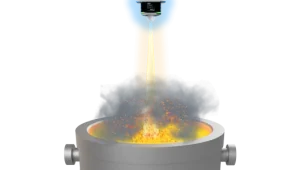
For optimal control of molten steel or aluminum during scrap metal recycling, it is important to continuously and accurately measure the fill height in the melting furnace. OndoSense radar sensors provide high-precision level control of liquid metal in melting furnaces – even at metal temperatures of up to 1600 degrees Celsius. Level monitoring is also possible in closed furnaces. In this case, the radar sensor measures through a small opening in the furnace lid using a special housing.


High-precision radar for level measurements.
OndoSense apex. Ultra-precise. Fast measurements. Very robust.

Smart radar sensor for distance measurements.
OndoSense reach. Compact. Reliable. Outdoor-proof.

Your inquiry on our industrial radar sensors.
Please contact us now for advice & quotes.
You are interested in our industrial radar sensor technology for distance measurement, level measurement, positioning and collision avoidance? Any further questions? The OndoSense team will provide you with answers, advise you on the use of radar sensors in your industrial environment and send you a quote.