Distance sensor types: Why radar has the advantage
Where radar distance sensors have the edge over laser & ultrasonic
Distance sensors – also known as position, displacement or proximity sensors – do not only measure the interval between the device and an object: As a matter of fact, a distance measurement sensor can be used to determine fill levels, measure the dimensions of objects, check the positions of vehicles or objects and avoid collisions by detecting obstacles. Meanwhile, more and more radar sensors are used for distance control in the industrial sector. The reason: In comparison to an ultrasonic or laser distance sensor, radar sensors are able to measure reliably even in the presence of steam, smoke, dust, dirt, vibrations or extreme temperatures. Moreover, OndoSense's high performance radar distance sensors offer a measurement precision in the micrometer range, which is comparable to the accuracy of advanced laser distance sensors.
What are distance sensors? What are they used for?
Distance sensors are used for dimensional measurement, level control or collision avoidance
-
What is a distance sensor? What is a proximity sensor?
Basically, a distance sensor – also known as a displacement, proximity or position sensor – measures the distance between a reference point on the sensor and a target object. Then, the sensor transmits the changing distance value via an interface to a control unit (e. g. a programmable logic controller or PLC). Generally, the faster the measured distance changes, the more often the sensor has to measure in order to correctly map the distance change. As a result, the measurement rate of a distance sensor is an important quality feature, as is its measurement accuracy and range.
Also, there is a difference between distance and proximity sensors (or proximity switches): In contrast to distance sensors, proximity sensors cannot determine an exact distance value. However, proximity switches can detect an object at close range, e. g. as soon as a defined threshold is reached.
-
How does a distance or displacement sensor work?
Contactless distance sensors measure the distance to a target object without touching it. In brief, the sensor emits a signal in the form of sound waves or electromagnetic waves (respectively light). When the signal is thrown back by the target, the sensor subsequently receives the signal back and measures its runtime. As a result, the distance can be calculated using the exact length of time and known parameters such as the speed of sound or light. Both ultrasonic and laser distance sensors work according to this principle. However, FMCW radar sensors determine the distance by measuring the frequency shift between the emitted and received radar signal. Moreover, very precise laser sensors calculate the distance via triangulation.
By comparison, tactile displacement or position sensors measure the distance to a target object by touching it or are connected to the object via a cable pull. These sensors include, for example, draw wire sensors or inductive displacement sensors.
-
What are distance sensors used for?
Whether for dimensional measurements, level control or collision avoidance: Distance, displacement or position sensors are undoubtedly used in many applications and industries. In manufacturing, for instance, displacement sensors are used for the precise measurement of products in quality control. Furthermore, contactless distance sensors control the level of liquids or solids in silos and tanks – for instance in the food, chemical or pharmaceutical industries. Moreover, displacement or position sensors also measure bulk material heights or throughput on conveyor belts. They are also used to position material handling equipment, robots, cranes or mobile robots. Similarly, distance measurement sensors can also detect obstacles to avoid collisions in the automotive, transport and logistics sectors.
-
How accurate is a distance sensor?
How accurately contactless distance measurement sensors measure depends not least on the measurement technology used. For instance, OndoSense radar sensors feature a measurement accuracy in the micrometer range. This accuracy is also achieved by triangulation-based laser distance sensors. However, even fine dust particles, raindrops, rough materials or surfaces in certain colors can prevent the measurement of laser sensors. Radar-based distance measurement sensors, on the other hand, measure reliably even with steam, dust, extreme temperatures or vibrations. Consequently, they are particularly well suited for harsh environments or outdoor use.
With ultrasonic distance sensors, reliable measurements with sub-millimeter precision are only possible to a very limited extent, because the sound wave velocity changes depending on temperature, pressure or humidity. Also, in contrast to radar, dirt or dust on the lens of the ultrasonic sensor has a major impact on the measurement precision.
-
What range does a distance sensor have?
In short, the range of a distance sensor is the smallest and largest possible distance range in which the sensor can detect an object. However, this measurement range varies greatly depending on the type of sensor. Generally, ultrasonic distance sensors have a range that starts below 100 mm and is usually limited to about 15 meters. Nevertheless, dust, noise, high humidity and sound-absorbing targets can further reduce this range. By comparison, FMCW radar sensors can measure up to 50 meters and more. For very long distances with small targets, the use of radar reflectors may be necessary for a strong radar signal. The minimum measuring range of distance radars is 0.3 to 0.5 meters, however OndoSense radar sensors can already measure from 0.1 meters.
With laser triangulation sensors, precise distance measurements are possible from below 100 mm - but only up to a few meters. In contrast, time-of-flight laser sensors offer a much longer range – sometimes up to one kilometer – nevertheless with significant limitations in terms of measurement accuracy and object recognition (special reflective tapes are usually needed).


Smart radar sensor for distance measurements.
OndoSense reach. Compact. Reliable. Outdoor-proof.

High-precision radar distance sensor.
OndoSense apex. Ultra-precise. Fast measurements. Very robust.

What types of distance sensors are there? What are advantages of radar?
Where the radar distance sensor has the edge over ultrasonic or laser distance sensors
-
How a laser distance sensor works
In general, there are two types of laser sensors for distance measurement: Firstly, triangulation laser sensors, which are very precise, and secondly time-of-flight laser sensors, which have a longer range. In brief, time-of-flight lasers determine the distance between the sensor and the target by measuring the time of travel of the signal. For this purpose, the sensor emits a laser beam and measures the time required for the signal to return to the sensor after being reflected by the target object. Then, the laser distance sensor calculates the distance using the signal's runtime and the speed of light.
By comparison, the triangulation laser measures the distance using an angle calculation: In short, the sensor emits a laser beam, which is thrown back by the target object. Depending on the distance, the beam hits the receiver of the laser sensor at a certain angle. Subsequently, the sensor determines the exact distance to the object based on the angle and the distance between the transmitter and receiver.
-
How an ultrasonic distance sensor works
Basically, ultrasonic distance sensors measure distances by emitting sound pulses at a very high frequency and evaluating their time of flight. Then, the sound waves are reflected on the target object and received by the sensor. Since the speed of sound (about 340 m/s in air) is known, the ultrasonic sensor can calculate the distance based on the time between the emission and reception of the sound waves. Due to their limited measurement range and low measurement rate, ultrasonic sensors are not suitable for measuring fast-moving targets.
-
How a radar distance sensor works
Almost all radar sensors for distance measurement are based on the frequency-modulated continuous wave radar. In short, FMCW radar sensors emit a radar frequency that increases or decreases steadily over a defined frequency band range (e. g. from 122 to 123 GHz). This radar signal is reflected by the target object and subsequently received by the radar sensor. Then, the exact distance can be calculated from the frequency shift between the transmitting and receiving signals. More information can be found on our FMCW radar page.
-
Radar distance sensors: the advantages
Radar sensors for distance measurement have some advantages compared to laser or ultrasonic sensors when it comes to reliable, precise and fast distance measurements. First of all, radar sensors operate at a significantly higher wavelength than laser sensors, so that e.g. dust particles or steam do not interfere with the radar signal. Therefore, radar distance sensors measure reliably even in difficult conditions with dirt, rain, snow or smoke. Moreover, OndoSense radar sensors offer a real-time capable measurement rate as well as a measurement accuracy in the micrometer range, as it is the case for precise laser sensors.
In addition, the propagation speed of radar waves is constant and does not depend on temperature, pressure or humidity, as with ultrasonic waves. Therefore, precise distance measurements are possible even in adverse environments and outdoors. Also, dirt on the lens does not affect the distance radar. Furthermore, there are no moving parts or sensitive optics in radar sensors compared to lidar sensors. As a result, radar technology is very low-maintenance and robust.
In the following graph you will find a comparison of different sensor technologies for distance measurement (laser, ultrasound and radar):
Sensor performance | Radar 122 GHz | Ultrasonic ToF | Laser ToF | Laser Triangul. |
Measuring with dust, dirt, smoke, fog, water drops, snow | 3/3
| 2/3
| 1/3
| 1/3
|
Robustness against vibrations, extreme temperatures, difficult light conditions, pressure variations | 3/3
| 1/3
| 1/3
| 1/3
|
Measuring through plastic, glas etc. | 3/3
| 2/3
| 1/3
| 1/3
|
Accurate distance measurement | 3/3
| 1/3
| 2/3
| 3/3
|
Wide measuring range | 3/3
| 1/3
| 3/3
| 1/3
|
Measuring tilted object surfaces (non-perpendicular) | 2/3
| 2/3
| 3/3
| 3/3
|
Acquisition costs | 2/3
| 3/3
| 2/3
| 1/3
|
Low-maintenance sensor | 3/3
| 2/3
| 1/3
| 1/3
|


Smart radar sensor for distance measurements.
OndoSense reach. Compact. Reliable. Usable outdoors.

High-precision radar distance sensor.
OndoSense apex. Ultra-precise. Fast measurements. Very robust.

Where radar distance sensors are used
Radar sensors for distance measurement are used in many industries and applications
-
Height control of the sprayer boom with radar distance sensors
Radar sensors for distance measurement are established in many industries and applications to automate processes and achieve greater productivity. In the automotive sector, radar distance sensors have been used for decades as parking aids or for adaptive cruise control.
But radar sensors are also used in agriculture, e.g. for precise height control of the sprayer boom of tractors. The distance sensors detect the arable soil with high accuracy and speed, even in spray mist or dirt. As a result, the field sprayer maintains the optimal distance from the ground at all times. This reduces the costs of fertilizer or pesticides and leads to increased productivity in the use of agricultural machinery.
-
Positioning of crane booms with radar sensors
Cranes are indispensable when it comes to lifting, moving and loading heavy and sensitive loads. With a radar distance sensor, crane booms or other moving crane parts can be accurately aligned to precisely move loads and prevent collisions. Furthermore, radar sensors enable the reliable position control of construction, container and port cranes in all weather conditions.
Position control of crane booms with a radar distance sensor -
Monitoring the bridge condition with a radar distance sensor
In many countries, the condition of bridges must be continuously monitored for safety reasons. With OndoSense radar sensors, bridge vibration and deflection can be detected with high accuracy when heavy vehicles are crossing. For this purpose, the radar distance sensor is mounted below the bridge and then continuously measures the distance to the road surface. This radar-based bridge monitoring can be used to determine even the smallest vibrations of the bridge with micrometer precision.
Bridge condition monitoring with an ultra-precise radar distance sensor -
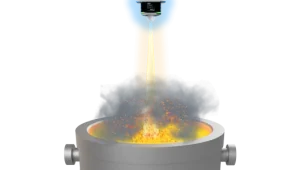
Fill level monitoring of molten metal with radar sensors
Robust and powerful sensors are required for the high-precision level measurement of liquid steel or aluminum. With the radar distance sensors from OndoSense, the level of liquid metal can be measured with sub-millimeter accuracy even at temperatures of up to 1600 degrees Celsius. In most cases, it is not necessary to actively cool the radar sensor.
Level measurement of molten steel or aluminum with a radar distance sensor -
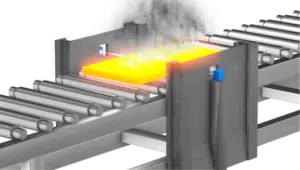
Measurement of steel slabs with radar distance sensors
For a reliable quality of steel and aluminium products, the accurate measurement of semi-finished metal products in the rolling mill is essential. The radar distance sensors from OndoSense can be used to determine the width of hot steel, aluminum or copper plates with an accuracy of up to ±300 μm. This enables rolling mills to save significant amounts of crude steel, reduce CO2 emissions and lower production costs.
Width measurement of steel slabs with radar distance sensors


Smart radar sensor for distance measurements.
OndoSense reach. Compact. Reliable. Usable outdoors.

High-precision radar distance sensor.
OndoSense apex. Ultra-precise. Fast measurements. Very robust.

Your inquiry on our industrial radar sensors.
Please contact us now for advice & quotes.
You are interested in our industrial radar sensor technology for distance measurement, level measurement, positioning and collision avoidance? Any further questions? The OndoSense team will provide you with answers, advise you on the use of radar sensors in your industrial environment and send you a quote.